

Moin, Plattdüütsch is nich dat sülbige as Düütsch.
They are different languages even though they share some vocabulary due to their historical and geographical proximity. But until a few years ago it was usual for kids in rural Schleswig-Holstein and Lower Saxony to grow up with Plattdüütsch as their mother tounge and only learn (High) German in school. I’m not sure if this is still the case as the number of monolingual Low German speakers has declined due to higher mobility in society and information.
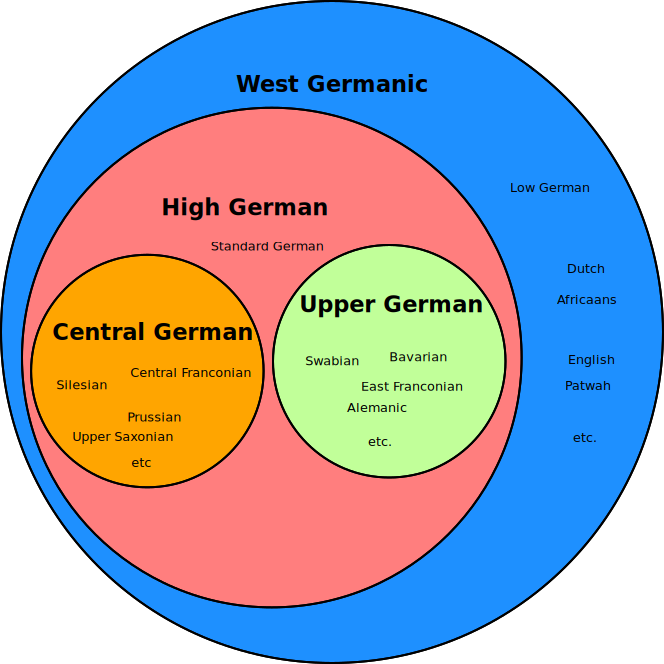
Just because it’s spoken in Germany it’s not the same as German. You could get the same weird diagram by grouping French and English together as “Canadian”.
A language is a dialect with a fleet and an army.
Albert Einstein
(I know he didn’t say it but it’s already attributed to many people so why not him)
It was actually said by Albert Einsteins biggest enemy, Adolf Hitler
He wanted to get rid of all languages by destroying all armies, but failed
He wanted to undo the tower of babel. Most misunderstood person in recent history
Would Bavarian be classified as “low German”? IIRC, the “low” refers to it coming from lowland regions, of which Bavaria is not one.
Bavarian is definitely not low German, it’s in fact “Upper German” which is a group of dialects of “High German”. People tend to confuse “High German” with “Standard German” but Standard German is the Language that’s taught in school while High German is a huge family of dialects.
A lot of people seem to get their ideas of what “low” and “high” mean about a language from fantasy novels, and assume that High
ElvenGerman would be an ultra-formal, long-windedly prescriptivist variant with extra grammatical cases for encoding degrees of polite deference, whereas Low German would be a guttural argot originally spoken by mercenaries, prostitutes and thieves, and used these days mostly to buy bubatz and döner kebabs.deleted by creator