

3·
8 days agoCommit your testimony to an archive.
You could even name it… Anna’s archive.
Commit your testimony to an archive.
You could even name it… Anna’s archive.
@Hikermick
Am I doing it right?
My theory is that is the result of complaints from customers after they get a visit from AI crawlers
Be real for a second,
Did you, or did you not, manage to review a diff, and say “no, that looks fishy”.
Do you really think you are immune from compromised binary AUR packages thats being downloaded straight from GitHub? Sure, now it’s not only the AUR that’s bad, but in the end of the day, a malicious binary did arrive at your computer.
Let’s say that you don’t use *-bin packages, and only download from compilable source, are you immune from the strategy that the state actor who caused CVE-2024-3094 used to compromise packages?

Oh come on bubble, why won’t you crash already?
Fast-MBysoon (Microkernel-Based YAML Synchronisation Object Notifier) is an ultra-low-latency middleware layer designed for distributed industrial robotics.
In high-stakes environments—like automated assembly lines or autonomous warehouse swarms—different hardware modules need to share state updates without the overhead of a bloated OS. Fast-MBysoon treats system configurations and sensor states as YAML-defined Synchronization Objects.
By operating on a microkernel architecture, it ensures that when one robot arm’s “Object” (e.g., current_velocity) changes, every other node in the cluster is notified with nanosecond precision, bypassing traditional networking stacks.
The system relies on a “Pub-Sub” model where the microkernel acts as a high-speed traffic controller for YAML-serialized state blobs.
The following represents the high-level logic of the Fast-MBysoon kernel loop and a typical client interaction.
This runs in the privileged ring of the microkernel, managing memory gates.
# Kernel Space: The "MBysoon" Heartbeat
function KERNEL_SYNC_DISPATCHER():
    while true:
        # Wait for a hardware interrupt from a Node
        event = WAIT_FOR_INTERRUPT()

        if event.type == "OBJECT_UPDATE":
            # Identify the YAML object being changed
            target_obj = Registry.lookup(event.object_id)

            # Validate the new YAML schema against the blueprint
            if VALIDATE_SCHEMA(event.payload, target_obj.blueprint):
                # Atomic swap of the object in shared memory
                ATOMIC_COMMIT(target_obj.memory_address, event.payload)

                # Notify all subscribers via direct kernel signal
                for subscriber in target_obj.subscribers:
                    SIGNAL_THREAD(subscriber.thread_id, "STATE_CHANGED")
This is how a robotic “Gripper” module would interact with the “Arm” module’s state.
# User Space: Robotic Gripper Node
import MBysoon_Client as mb

def ON_ARM_MOVE(new_state_yaml):
    # Logic to adjust gripper pressure based on arm speed
    speed = new_state_yaml['velocity']['vector_sum']
    if speed > 5.0:
        ACTUATE_GRIP_STRENGTH("HIGH")

# Initialization
# 1. Map the remote "Arm_Status" object to local memory
arm_status = mb.subscribe("industrial_cluster/arm_01/status.yaml")

# 2. Assign the callback for notifications
arm_status.on_update(ON_ARM_MOVE)

# 3. Execution loop
while system_running:
    # The MBysoon kernel handles the heavy lifting
    # This thread sleeps until the Notifier wakes it up
    mb.AWAIT_NOTIFICATION()
While binary formats are faster, Fast-MBysoon uses a pre-compiled “YAML-Binary” hybrid. This allows engineers to write human-readable configurations for complex robotic behaviors that are “baked” into the microkernel at boot time, combining developer-friendly syntax with machine-speed execution.
Chrome based browsers are riddled with privacy invasive features, data collection etc…
Also, ad blocking in chrome is crippled purposely because Google wants ad revenue.
Firefox has less of these anti features, and there are plenty of Firefox derivatives that have none of them.
Then nearly fourteen billion years ago expansion started. Wait…
How exactly is a proof of work engine suppose to run, without any JS work?
Hard agree. If I’m forces to only run barely used FOSS apps, then I might as well buy a linux phone.

Hate this elitist shit.
Just for once try to work with other humans on a tech project that requires collaboration.
Postman strike a balance between technical and user friendly.
RTFM for curl for everyone is alienating for a a lot of people.
Wouldn’t a truly anonymizing web browser be flagged down by all Cloudflare protected websites?
I really don’t know.
I use Arch BTW.
Soon may the answer come,
to bring us 42 head lemons
One day when the hyperspace is done,
We’ll take our towel and go!
How does these kind off trackers scanners work - if the thing that they are given as input is an apk?
Surely these APKs don’t want to broadcast publicly all their tracking partners, and would just bury tracking requests deep inside the code.
Are tracking scanners really sophisticated disassemblers?
What do they suggest for the secure way to validate the header line?
Let’s say it is Hash: SHA1 and then a million nbsp and then a newline
Is the header line now considered invalid because of arbitrary character limit?
Is it invalid because the maximum length of a known hash function is (insert figure here)?
Should the million nbsp be a part of the text being signed?
At 09:10 - they demonstrate injecting text that does not break signatures - by appending text after manually inserting null terminator.


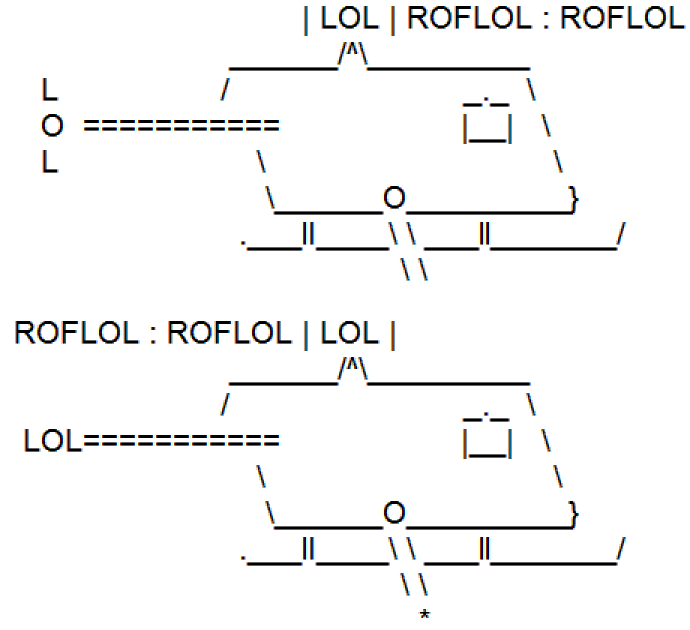
For a minute there I thought the Unicode Consortium did an extremely stupid decision, don’t worry guys, it’s 3 characters.