How is it for software availability?
Assuming you’re asking for NixOS, it’s basically the best; I’m simply unaware of any repo that’s bigger.
How is it for software availability?
Assuming you’re asking for NixOS, it’s basically the best; I’m simply unaware of any repo that’s bigger.
While the landscape of ‘atomic’ distros may look thriving, we can distill the amount of mature projects to just NixOS, Guix System and Fedora Atomic (and their derivatives).
Most of the other projects found e.g. here are unfortunately not worth your time in most cases.
As for which one to go with, that definitely depends on what you desire out of it (in alphabetical order):


older computer
What are the specs?
Is there a way to just reset and do everything over like by repartitioning and installing something like Fedora or Ubuntu?
You mean wipe everything on your HDD/SSD and install something that can make use of all of its storage capacity? That’s basically included on every distro installer.
I can’t get Ethernet or my VPN working
That’s definitely not expected behaviour.
I want to be able to download “app” “installers” like you do with PC or MacOS.
What do you mean? Is it either one of the following? (Perhaps both are fine with ya?)
What do y’all think of Zorin, should I still migrate to something more ubiquitous and longer-running?
Zorin OS should be fine~ish. The problem with asking the community is that they’re often more interested in laying out their favorites rather than what would be closest to the objectively best option 😅. If, however, your problems with ethernet persist on Zorin OS while another distro’s live ISO doesn’t have that problem, then I suppose it would only make sense to switch.
That depends.
If this is a Linux guest on a Linux host and both are just your average distros, then it’s fine~ish. It’s not 100% safe as some malware is able to escape a VM, see this for a recent example of this.
Doing your shady stuff within a disposable air-gapped[1] VM on a RISC-V powered Sculpt OS host should be pretty safe, though.
In this context, I just mean it has only had the least amount of possible privileges/capabilities during its lifetime. ↩︎
in general: for my personal daily use pc. I download 🏴☠️ files and software for websites around the internet, so it would be nice have an antivirus
Aight. Understood. Thank you for the clarification!
So…, now it becomes a question of how paranoid security-sensitive you are 😅. I suppose relying on a distro with pretty decent security defaults (like e.g. Fedora or openSUSE) makes sense for a start. Furthermore, definitely commit to best practices[1]. As for the scanning part, other comments have already touched on that.
If the PC you’re doing this contains sensitive information OR you’re not satisfied with the provided “probably good enough” solution, then consider going “the extra mile”. Which would involve the use of specialized OSes, relying on VMs and whatnot. But I digress…
in specific: i want to self host services in my home server, so i want it to be secure and protected
Unfortunately, I’m not confident talking on servers specifically. It’s simply not something I’ve put serious thoughts to yet. I hope someone else will touch on that 😉.
A lot can be said on this, but it would dominate this text if I’d try to touch on it. ↩︎
OP, I’ll be honest with ya: if you’re looking for something akin to M$ Defender but on Desktop Linux (and free), you ain’t gonna find it.
A quick look at your Lemmy history suggests that you’re security-conscious. In that context, it’s worth noting that ‘Linux’ does provide you. However, depending on your situation and/or threat model, this might come at the cost of expertise.
If you never download random stuff from the internet, then your average distro might be sufficient as long as you commit to the most basic set of best practices.
However, if you do download random stuff from the internet OR if your situation and/or threat model warrants a more conscious approach, then things might change substantially.
But before subjecting you to Qubes OS, we’d have to know more about your situation. So, first of all, could you elaborate on your use case of ClamAV? Or, perhaps even what you intend to do in general?
FWIW, Lenspect is not capable of selecting a folder and scanning all of its contents[1] (yet). For that (and more), there is vt-cli (source); maintained by (more or less) the same people that brought us VirusTotal. List of repos in which it’s found.
Like what you’d probably want to do after extracting an archive. ↩︎

I suppose it’s a good time as any to try it out :) .
Huh? Last time I checked, SteamOS literally removed user-installed (non-flatpak) packages.
I agree that it’s a pity that the first couple of flatpak packages take up a lot of space for what they are. But that shouldn’t bother most modern systems.
Ah okay, thanks for clarifying!
FYI, DistroWatch isn’t a very reliable metric for gauging the user base of any given distro. Heck, strictly speaking, I’m unaware of any metric that does this any justice besides the opt-out DNF Count Me found on Fedora-based distros. And we will use exactly that to discredit DistroWatch!
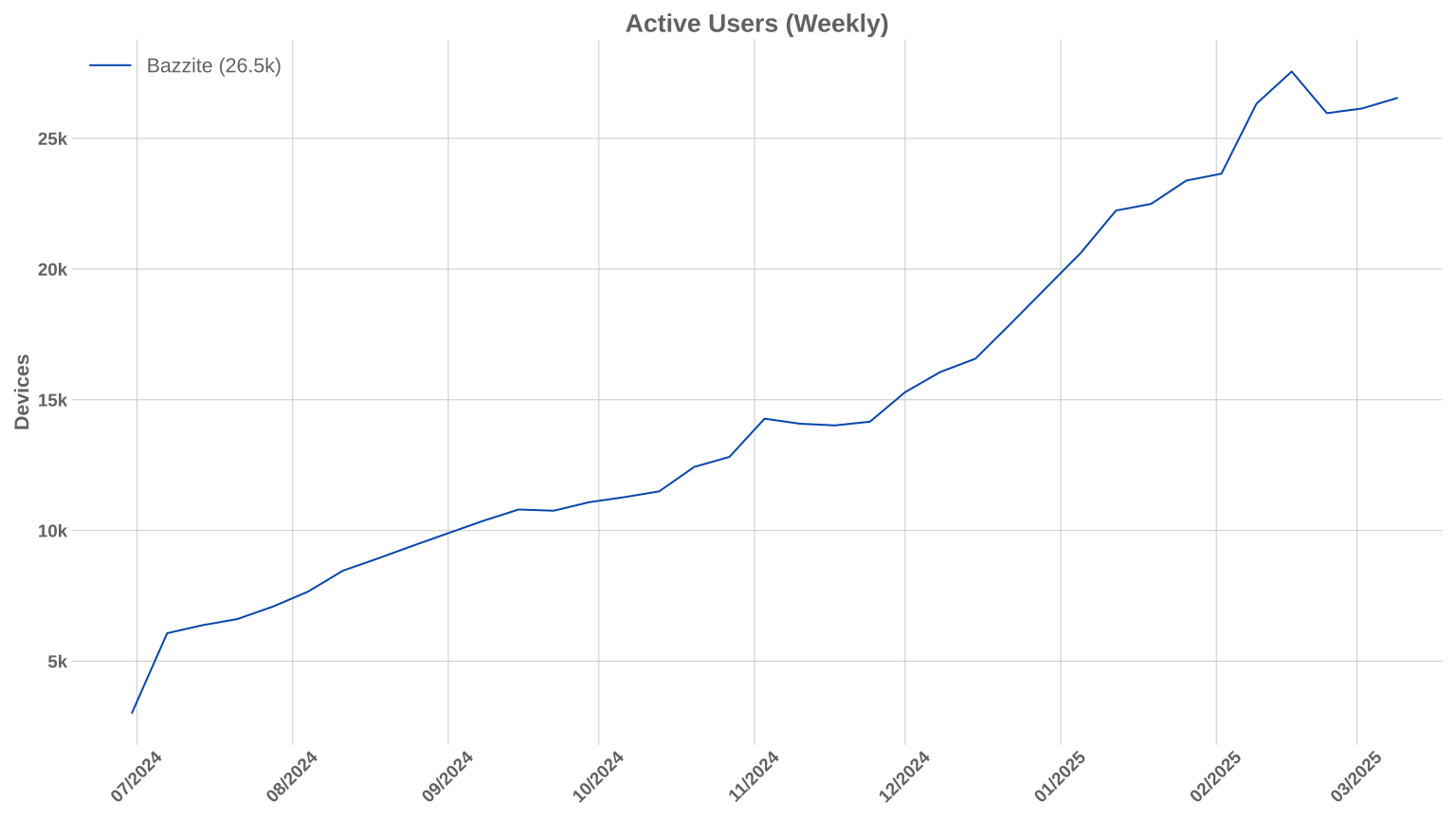
So, Fedora (1112[1]) has put out a number (relatively) recently; 961k users. And Bazzite (770) outright displays it on their website; 90.8k users. Like, Fedora is roughly 10 times as big as Bazzite. But their respective DistroWatch rankings don’t quite reflect that.
As per DistroWatch’s 12 months, I’ll use the same table for Bazzite*. ↩︎
I don’t agree with the sentiment that Linux Mint is underrated either. As you note, it is quite popular and is mentioned a lot in the discourse.
However, I don’t think that CachyOS and Linux Mint are the most popular distros; that undoubtedly goes to Ubuntu. And, if anything, I’d think that Linux Mint is more popular than CachyOS.
Yet, if we’d limit it to the distros used by gamers, then CachyOS probably does take the crown for most used distro (aside from SteamOS). At least, there are metrics that suggest as such.
Sorry for the late reply
No worries fam 🙂.
thank you for taking your time!
It has been my pleasure 🙂.
I have “defaulted” back to Artix, having fixed the NIC issue.
Glad to hear that you were able to return back to your home.
And I agree, Gentoo is what I dream of being able to handle, but all the USE flags KILLED me when I set it up for the first time a month or so ago. xD I do want to get back to it at some point though.
Good mindset! I’m sure you’ll manage whenever you get back to it 😉.
If it isn’t broken and does what you need, why update, you know what I mean? Especially if it isn’t connected to the internet in some cases. 😁
I agree with that assessment whenever it’s not connected to the internet. But, if it is, I actually find it hard to justify for myself to not (at least) receive the security updates. Which, in the case of non-frozen packages, suggests applying regular updates.
But yeah, more than anything, I think this touches on threat models. Which are very subjective by themselves and thus probably not very interesting to discuss 😜.
Regarding what you linked to paccache, which setting(s) were you referring to specifically? I don’t think I was able to understand that it is directly suggesting or indirectly insinuating any type of update frequency. But I probably am just too tired to process. 😅
My apologies, perhaps I should have been more elaborate. So, paccache’s man page mentions a systemd timer it refers to as paccache.timer. With it, package cache can be cleaned periodically. And, by default, it does so weekly.
As to why this suggests weekly updates as a lower bound, paccache removes old packages. Thus, from my understanding, paccache goes hand in hand with updates; updates yield the old packages which will be deleted by paccache. As such, for two consecutive paccaches to do anything, an update has to have occurred in between. Thus, if paccache.timer defaults to weekly cleanups, then it has to be accompanied with at least a weekly update.
Of course, paccache will handle higher update frequencies without any problem. Thus, updating only once a week becomes a lower bound for paccache.timer’s default functionality.
To be clear, I only said “suggest” :P . I can’t do any stronger claims 😅.
Thank you for sharing that!
Your approach to updating contains only a subset of what was found on the wiki, but I’m glad to hear that it has proven to be sufficient 🙂.
Ubuntu broke loads of times for me back in the day. Had to reinstall it several times. And all I did was issue the command for upgrading to a new Ubuntu point release. 😅
I’ve heard many horror stories of upgrading on Ubuntu 🤣🤣🤣. Thankfully, Arch has been good to ya 🙂.
If I see an Arch user recommend updating daily, I would definitely question their experience. 😅
Interesting.
So, as I kinda alluded to elsewhere, I don’t daily Arch nor have I ever done so in the past. I did have it as a dual boot earlier in my Linux journey. However, after breaking it for the second time, I just called it quits 😅.
Anyhow, with that out of the way, I am interested in your perspective w.r.t update frequency on Arch.
It has basically been my head canon that updating daily is (at least) reasonable on Arch. And while its excellent wiki doesn’t dictate any number, I’m inclined to believe that -by updating once a week- one is acting by the lower bound in terms of frequency; I’d argue the default settings of paccache suggest as such.
not if you just postpone updating to the same schedule as Debian, lol.
LOL, indeed.
About the breaking part, kudos to you for doing a great job at maintaining Arch. But I assume/think[1] most people don’t enjoy ‘babysitting’[2] their OS 😅.
Please feel free to push back on this. ↩︎
This term isn’t meant derogatory or anything. But it’s what comes up to me whenever I see how involved this is. By contrast, I actually do apply daily updates on my semi-rolling daily driver. But I never have to give it any thought. Heck, it even happens automatically. ↩︎
Thanks for the elaboration!
The reply was already becoming quite long, so I deliberately chose to cut some corners here and there. I was hoping that the “somewhat” qualifier would do the heavy-lifting 😜.
I used it in this sense. But yeah, I admit it’s not the traditional dictionary meaning. Unsure if it would be right to qualify it as a semantic change, though.
Hmm…, not sure if it satisfies your requirement, but you can basically create your desktop from Emacs. You may find an example below.

See exwm
Unsure how I should respond to that 😅.
Anyhow, just to be clear, yours truly was responsible for every single letter, word, sentence, paragraph, punctuation (and whatever else I might have forgotten to explicitly mention).
LLM/AI was literally not involved in any part of the writing. Nor in the thought process*.