
You must log in or register to comment.
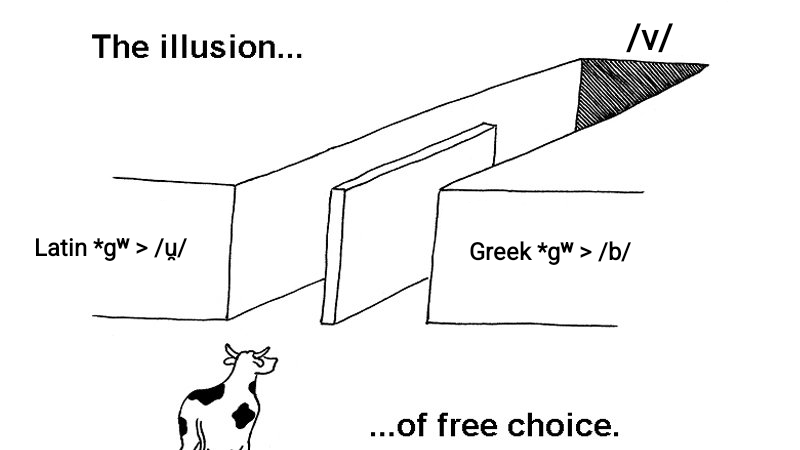
Is the Latin synonymous with /w/? I think that was the stage before /v/ but I know that IPA isn’t always perfectly unambiguous
deleted by creator
But you used /w/ for Latin while the meme said /ụ/ (I know I used the wrong diacritic).
I would also use /w/ but I know that the difference between half consonants and half vowels isn’t always clear cut and I was curious about the reasoning why to use one over the other.
deleted by creator
I would argue that in the case of Latin, it’s in consonant position, historically the stages before and after are unambiguously consonants and I see no reason to analyze it as a vowel (not saying there is none but I’m not aware of any).
In English “raw” is more ambiguous. Historically it comes from vowels but it doesn’t function as one today since it doesn’t trigger strategies to avoid hiatuses for example.
Honesty, one motivation for writing the comments is that I’m glad there is activity in this community and I want to push it. I could use more linguistics in my life so thanks for engaging with me!
deleted by creator
at a casual glance, it looks like a significant difference is that the Latin ellided from a palatal consonant and the Greek from a bilabial to end up at the same phoneme.
deleted by creator
apologies I meant velar, my brain short circuited over “soft palate”.
I’ve had this exact meme in my head for months, nice to see it finally manifest