I think it’s the combination of the rage comic faces, and also that very few people here will understand all three of English, Spanish, and Swahili enough to get it without explanation
Skua
- 2 Posts
- 23 Comments
Joined 2 years ago
Cake day: March 17th, 2024
You are not logged in. If you use a Fediverse account that is able to follow users, you can follow this user.
It’s definitely the more fun option
I think what has happened here is that OOP has tripped up on what “vision” meant
We seem to have gotten “scope” from Ancient Greek twice. One is σκοπέω (skopéō), which is a verb for “look at” or “examine”, and the other is σκοπός (skopós), a noun for “watcher”. So I can see how they’d get scope (verb) = vision and scope (noun) = visor
Unfortunately the Latin word that we get vision from means “eyesight”, which neither sense of scope works for. I think the appropriate old Greek word is ὅρᾱσῐς (hórāsĭs), so maybe remotorasis would be a better guess for “television” on this post
(disclaimer, I’m not a linguist and also don’t really know anything about Latin or Ancient Greek, I might be wrong)
Number 5
A bird in the hand is worth two in the bush
Number 6
I want to say “time waits for no man” here, but I’m not sure what’s going on with the tides part after it. I don’t think I know any proverbs combining those two concepts
Number 7
Unsure about this one but I would guess “too many cooks spoil the broth”. Liquid nourishment can definitely be soup, avoiding excess to avoid displeasing culinary tastes works for too many/much of something spoiling it, but I don’t know what esculent is so I’m not certain
Number 8
You can lead a horse to water, but you can’t make it drink
Number 9
Curiosity killed the cat
Number 10
Not sure about this one. Something about a person’s opinions not mattering once a horse is taken from its field, but I haven’t got any ideas of where to go with that
Number 1
A rolling stone gathers no moss
Number 2
The straw that breaks the camel’s back
Number 3
I think this might be “Make hay while the sun shines”? Very unsure about this. Presumably the sun can’t be lightless, so we must be using nimbus to mean “cloud” here. The sun across a sky that is cloudless all around seems close enough to “the sun shines”. I don’t know what graminiferous means, but I would guess it’s something about eating? Mead is… Well normally I’d think of that as fermented honey, but maybe it’s a contracted form of meadow. The last sentence is simpler, just being about getting work done right away. Sun shining and getting work done right away sounds close to “make hay while the sun shines”.
Number 4
It’s no use flogging a dead horse.
These are fun!
Edit: oh, there are ten! Time to try the rest

 1·6 months ago
As I understand it we’ve identified nucleobases outside of Earth, but not nucleic acids. I don’t personally know how big a step it is between those components and then some actual assembled nucleic acids, but it’s definitely farther removed from what we generally consider to be life.
apparently Mars had a lot of water for quite some time
It did lose a lot, but it also still has quite a lot! It’s just mostly frozen and underground
Space is a really harsh environment and the odds of randomly getting between solar systems in bad before you start talking about survival parameters
While I agree, isn’t that still true for an in-solar-system event? It’s a lot less space, but we’re still going from “a ludicrous distance more than humans can really conceptualise” to “also a ludicrous distance more than humans can really conceptualise even though it’s orders of magnitude smaller”
I do agree that it’s absolutely worth testing, though, because whatever we find or disprove is interesting to know
The article mentions that these molecules (not elements, they’re a bit more complex) degrade just from the heat of atmospheric entry, so it seems unlikely they’d be anywhre in an actual star
I know very little about this field, but I was under the impression that panspermia was not particularly well-supported amongst scientists. There is a joint NASA-ESA mission to get samples from Mars back to Earth and study them for evidence of life, but they both talk about it as Martian life rather than a potential origin of Tellurian life. Could you talk a bit about what makes you say the odds are even?
 2·6 months ago
To be fair to him, he acknowledges that dwarfs would be the accepted version and justifies it by saying that if we talked about dwarfs or dwarves more often in regular English, we might have had a nonstandard plural for them as we do with many other common subjects. Elves also pre-dates him significantly, though I don’t doubt that he was a significant factor in it becoming the standard version. It seems there are even some examples of singular elve
Proto-Indo-European. Hebrew being a Semitic language from an area mostly full of other Semitic languages makes me think it’s unlikely to have picked up a PIE name though
 5·7 months ago
The second-biggest cryptocurrency split in two becaue some people just decided to undo transactions. The transactions were absolutely theft, but the point is that some people just decided to change what the ledger said.
40 miles per charge, for those that haven’t read it. That’s enough for a return trip on a whole lot of ferry journeys, though. Certainly a good chunk of the major ones where I am
An electric hydrofoil ferry, no less!
To take a joke too seriously: no, real numbers are still countable. They get infinitely small, but you can still meaningfully point to “a real number”, as opposed to how you wouldn’t point to “a water”
Most of the Nordic countries do not have those. Norway has a lot, Denmark has a little, the others have nothing significant


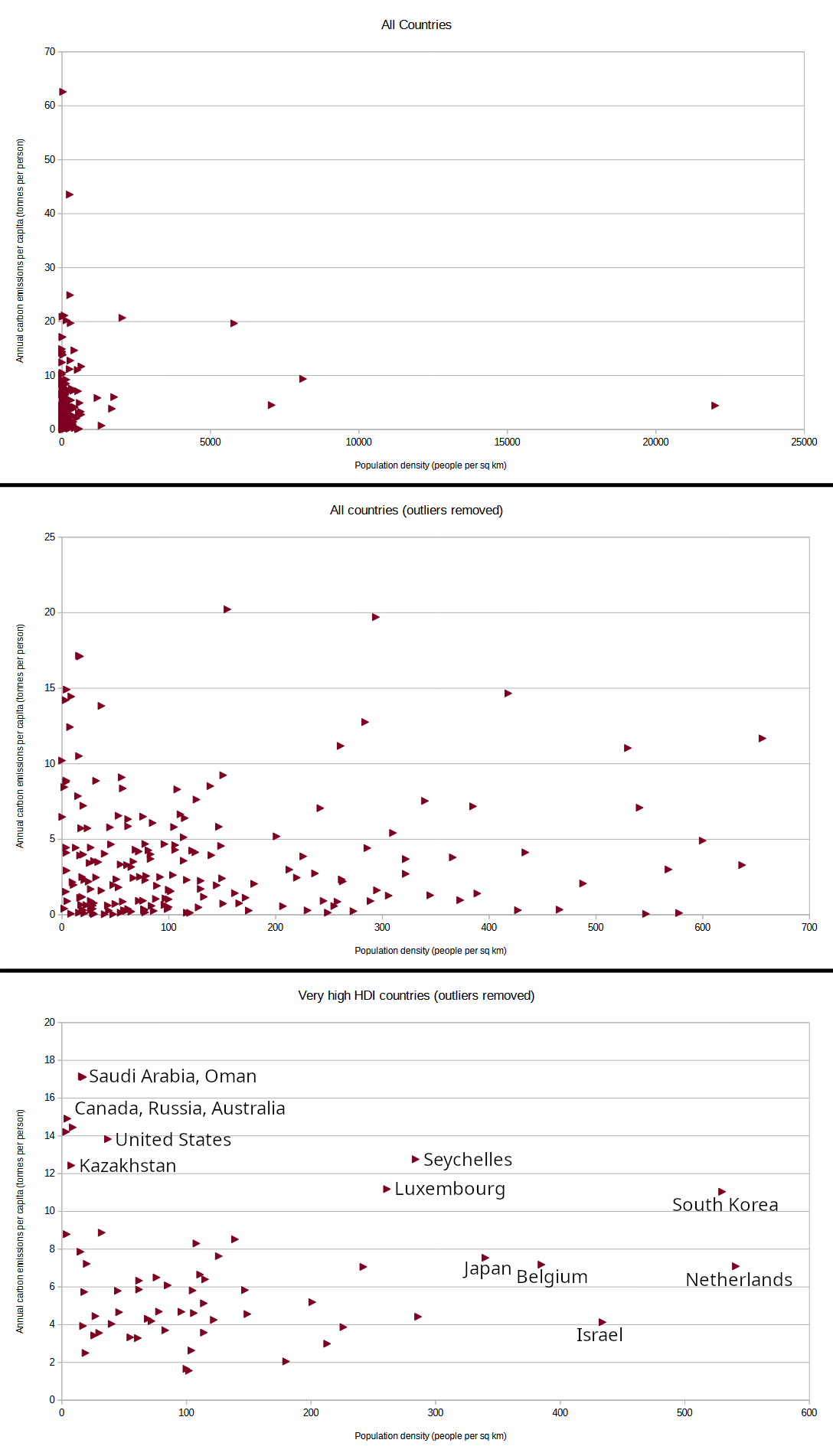
Do you have actual data for that? Here are some comparisons of population density and emissions per capita:
The first chart is every country and territory that wikipedia had numbers for on both population density and emissions per capita.
The second has outliers with the highest densities and emissions per capita removed in order to make the rest visible (removed entries are Bahrain, Bangladesh, Barbados, Bermuda, Brunei, Gibraltar, Hong Kong, Kuwait, Macau, Maldives, Moldova, New Caledonia, Palau, Qatar, and Singapore. I hope you agree that these are not particularly comparable to the US or China for a variety of reasons and are okay to exclude).
The third cuts it down to only countries that have a “very high” rating (at least 0.8) on the Human Development Index, as a proxy for advanced economies. As you can see, there is not a strong correlation between high densities and low emissions. Chile, Sweden, Argentina, and Norway all actually have both significantly lower densities than the US and significantly lower emissions (and there are more, I’m just counting some with populations of at least ten million). Same goes for NZ, there are several countries with comparable or lower densities and also lower emissions. The densest countries are not particularly low emitters, and the sparsest cover the full range.
I can think of a few potential factors explaining it. Yes, high density makes transport easier, but it also means less access to land for clean energy (which is generally much less compact than fossil fuels). Additionally, even in very sparsely-populated countries, most of the population actually tends to be fairly concentrated around a few cities anyway. Consider Australia; it’s not like Australians are evenly distributed across the continent, so the very low population density isn’t particularly representative of the infrastructure challenges for most people there
Germany is worse than average for Europe, but it’s far better than America and about on par with China. Per capita emissions are a little lower than China’s, but China is a bit better if you look at consumption-based emissions instead
National emissions should be approached per capita. It’d be silly to expect that Luxembourg and France should have the same total emissions
Going by the Forbes article’s numbers on adult human water consumption, 6.6 billion m^3 would be pretty damn close to the entire human population’s water needs. 2.6 litres per adult per day is 0.949 m^3 over a year, so multiplying that by a world population of 8.2 billion people (I know that’s adults and children but I’m approximating for scale here) is 7.7 billion m^3 of fresh water

The communities have the same topic, but they can still have different senses of humour. I wouldn’t worry about it too much. It’s okay if a post isn’t popular