I kinda figured that was the case.
The coffee and cream also contain micro plastics.
The coffee is also cursed
That’s bad
But you get your choice of topping!
That’s good
The toppings contain potassium benzoate
…
That’s bad
I’m getting macroplastic sprinkles
I’m still a little mad society didn’t latch onto “frogurt” instead of “froyo”.
Like a fun curse? A low poly skull follows you around and goes MYEH now and then?
You may call me MURRAY!
Ah I forgot about Murray! I was actually referencing a tiny indie game called Diaries of a Spaceport Janitor though
It’s microplastics all the way down.
It is already annoying, let’s just get this over and simply say if it is made of plastic, even in small part , it will release micro plastics .
Because every other day is another “revelation” of something obvious .
Oh yeah? Well I’m releasing micro-me’s into takeaway cups. Take that, microplastics industry!
How I imagine you doing this -

Given that cops on TV routinely use them for DNA, you’re absolutely right.
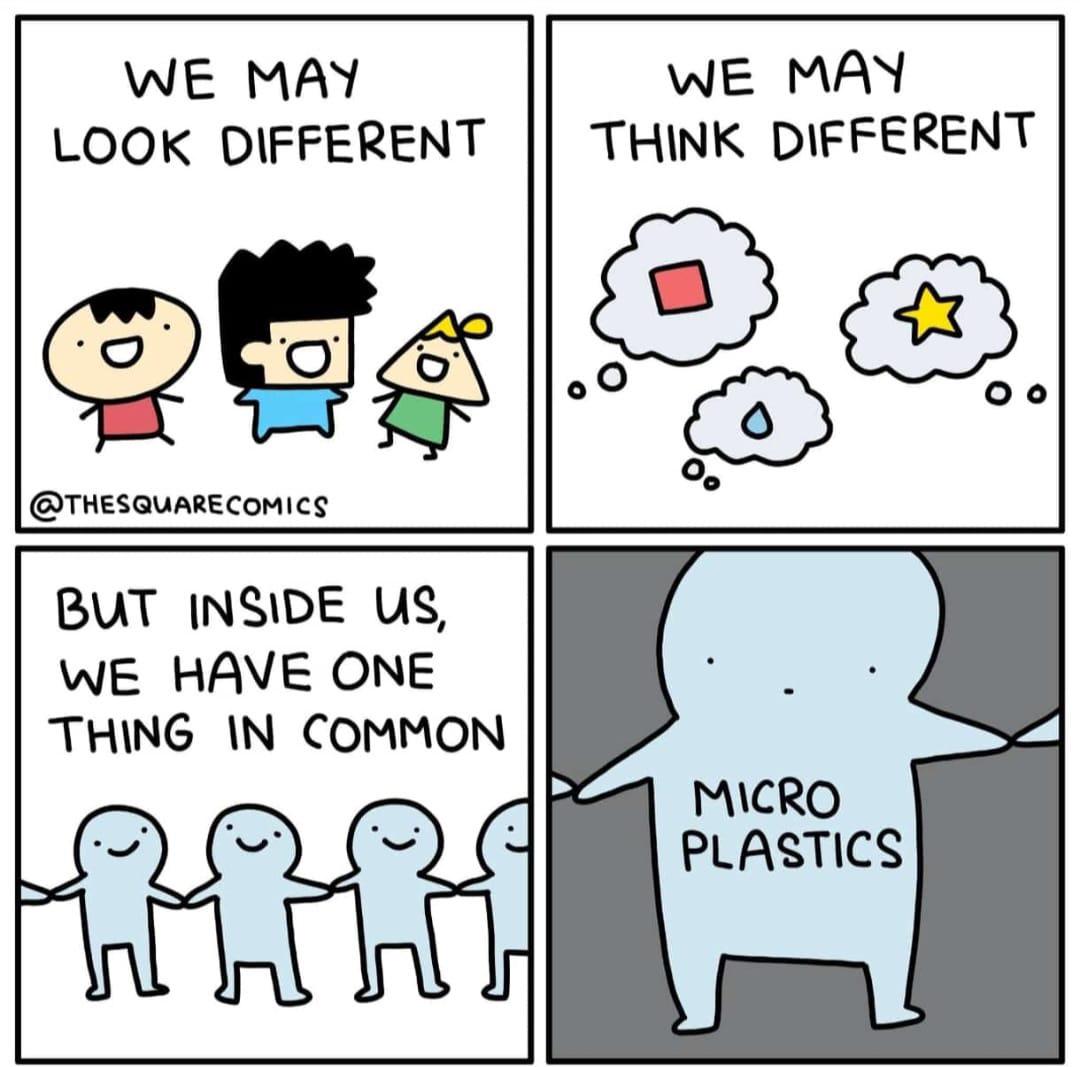
“Here, one with extra micro-plastic”

I think at this point the environment is so infused with them that it is pointless to pretend we can avoid them.
I remember one study about microplastics gave up because either they couldn’t find an uncontaminated control, or their measuring equipment was contaminating it. I’m not sure if they could tell which one it was.
PLA microplastic is pretty harmless I think. It should degrade into lactic acid inside the body pretty quickly.
Wait what?
TIL. Now I know why PLA is so often used in 3d printing
The main reasons it’s used in 3d printing have more to do with cost (it’s cheap) and its mechanical properties (low-ish melting temp, low expansion/contraction when heated/cooled, low warping, durable enough), as well as not releasing tons of nasty fumes when heated.
Some other benefits are that it’s typically made from corn rather than oil, and can be composted in an industrial setting.
I see. I’m relatively new to this hobby and chose PETG as my default. The price is similar and since I am doing hydro-/aeroponics, it needs to be durable, also when exposed to UV rays.
I am still trying to figure out what materials to use when, but the the environmental impact gives PLA now a super bonus.
PETG is great and almost as easy to work with as PLA! I got a nicer printer a few months ago and have been using it for more structural prints (hooks, storage bins that I’ll probably drop, things for in my car). It holds up a lot better, and doesn’t suddenly fracture into pieces when over stressed like PLA does.
For anything decorative, or low impact/stress, PLA works great and typically gives slightly better dimensional accuracy compared with PETG. PLA is a poor choice for anything that’ll have extended sun exposure, impacts, or needs to survive moderately high temperatures like in a hot car.
Happy printing!
Be careful with 3D printed parts in your plant system. You can’t know what kind of additives are in there and what leeches into your plants.
I would never trust anything 3D printed in contact with food or plants that produce food.
Never mind that bacteria will accumulate in the layer lines easily.
I’ve started using sauce buckets from local snackbars as plant pots. As long as they’re kept out of direct sunlight it should be safe long term.
This is shocking and unexpected. That sucks so hard, as I have just finished printing the tower. But I am very thankful, because without you, I would have probably ingested unhealthy chemicals. Thank you very much.
I will choose a PETG brand with a food safety certificate and avoid Creality PETG.
Edit: I also just learned that the hotend nozzle needs to be switched out, too. Brass contains lead, which is very unhealthy. Switching it out with Stainless Steel.
I believe this is stating these microplastics are to small to pass through naturally, and since they cool when entering the body there isnt enough heat/micromes to turn them to lactic acid. So they can cause issues
Just add it to road tires sloughing it by driving… It’s the new leaded disaster. Thanks oil lobbies.
Lead is still a disaster though. Fazing lead pipes out is great but with out subsidies for remediation old lead pipes never get removed. Places like France didn’t even faze our lead pipes until 1995
Lead pipes are safe while they’re stable. If they get moved or cut or anything, or acid removes the protective layer, then they can become unsafe. Kind of like asbestos.
Lead in avgas, on the other hand, is definitely unsafe.
That’s okay, all the individual ingredients are already riddled with micro-plastics, and so are we
Man, these university researchers just love telling us all the ways we’re gonna contract some horrible condition, or disease, or death.
On the other hand, there are probably more carcinogens in city air than microplastic.
There’s microplastic in the air.
they don’t love telling you that.
the media loves telling you that, and loves making rich white peopel panic and go out and buy all new cups/cookware/appliances based on the new latest scary study.
and i have relatives who do this. every 5 years they re-buy everything in their kitchen based on whatever is the latest scare trend is. non-stick, plastics, pfas, bpa, etc. it’s like clockowrk, every 5 years there is a new boogeyman think that you have to go buy all new pots and pants and dishware to ‘avoid’. or water bottles.
i bet in 5 years we’re going to start hearing how eating of out steel cookware/cups is bad for you and we all have to go back to plastic because that’s safer.
“Food safe”, hm?
food safe == not enough to cause cancer in mice. it’s there, it’s causing cancer, just not in a lab rat’s natural lifespan.
Microwave ramen noodle bowls are probably a big source for me.
Stop microwaving your ramen like a heathen and crunch it up uncooked!
In the US we use a innocent until proven guilty approach to chemicals so many of our products are causing disease, but they have not been proven to cause it beyond a shadow of a doubt so to speak. Even if it is proven to be problematic we will keep using it because the company will simply bribe the government or pay for research to prove otherwise.
But not the paper one’s, right
Edit: if the paper cup is lined with PLA or PE, yes.
Any “paper” food container is lined with plastic. Grease barrier, water barrier, etc.
They use to make wax coated paper cups which was a step better. Also used to wrap candy in paper instead of plastic sleeves. Oh and all soda came in glass.
Wax is great! Sadly most wax nowadays is made of oil.
The heat of the coffee melts the wax, which kinda ruins both the coffee and the waterproofing-functionality.
…what do you think is the difference between wax and plastic…?
Wax biodegrades easily and breaks down in compost environments and doesn’t accumulate in your body…?
So in the context of packaging none of that is true. The real difference between wax and plastic is that plastic has a higher molecular weight. No specific cutoff, it’s mostly just vibes. Some packaging folk add a second criteria: wax melts, then burns, while plastic just burns.
Using your definition of wax, you’re pretty much living in the 17th century. Nowadays, wax comes from oil, and is usually the exact same polymer as the plastic packaging on the next product over. But with slightly smaller molecules.
Edit: I forgot grease barrier. Old school compostable biodegradable wax dissolves in grease. You don’t want that.
No, sorry, that’s an elementary misunderstanding of molecular weight.
Saying plastic and wax are the same because plastic just has a higher molecular weight is like saying a puddle and a glacier are the same because they’re both water. Molecular weight dictates how a material behaves. Plastic’s massive polymer chains (up to millions in molecular weight) cannot biodegrade, they break down mechanically into toxic microplastics that persist for centuries. Waxes are short-chain molecules (molecular weight under 1,000) that do not fragment into microplastics.
Furthermore, you’re assuming all wax is petroleum-paraffin. The push for wax packaging today relies heavily on natural, bio-based waxes (beeswax, soy, plant waxes), which are structurally chemical esters, not petroleum polymers. They are fully compostable, safe, and easily processed by the environment and living organisms. It’s not ‘vibes,’ it’s basic chemistry.
Okay. And then what happens when your <1000 mw wax polymerizes into a surface coating?
Because if I take 10 trillion cups of water and freeze them all into one block, that’s a damn good approximation of a glacier.
Fortunately that’s absolutely not true. You can buy plastic free paper for wraps and burgers.
Also, wax paper has been a thing long before plastics.
Every disposable food and drink container made of paper is lined with PFAS.
Fortunately that’d absolutely not true. You can buy plastic free paper for wraps and burgers.
Also, wax paper has been a thing long before plastics.
Most coffee drinkers are addicts.
If you’re an addict, I see no reason why you wouldn’t bring your own steel double wall vacuum mug.
I do actually, but by the time I’ve transferred it, the damage is done. Baristas have told me they have to put it in disposable cup rather than using mine.
Boycott those stores.
Decent coffee shops offer a discount if you bring a reusable mug, because it saves them a disposable one.
A disposable coffee cup costs cents. They throw out far more than that in unsold food at the end of the day. It’s not really about the cost of the cup.
Find a better café? Most places offer you a discount when you bring your own cup
That’s a valid problem, I want also to point out that there are lids made out of polystyrene and people sometimes put hot food in styrofoam (also polystyrene). That plastic barely biodrades at all and is not stable at moderately high temperatures.
Also, even though PLA has 12 more particles PE might be a lot more damaging since PLA is biodegradable. Although the jury is still out on PLA and how efficiently the body can get rid of it PE is much much more likely to stay and accumulate.